June 18, 2026 at 5:45 a.m.

Long-tailed ducks on Lake Michigan

In-person hunter harvest survey in Two Rivers helps address minimal harvest information
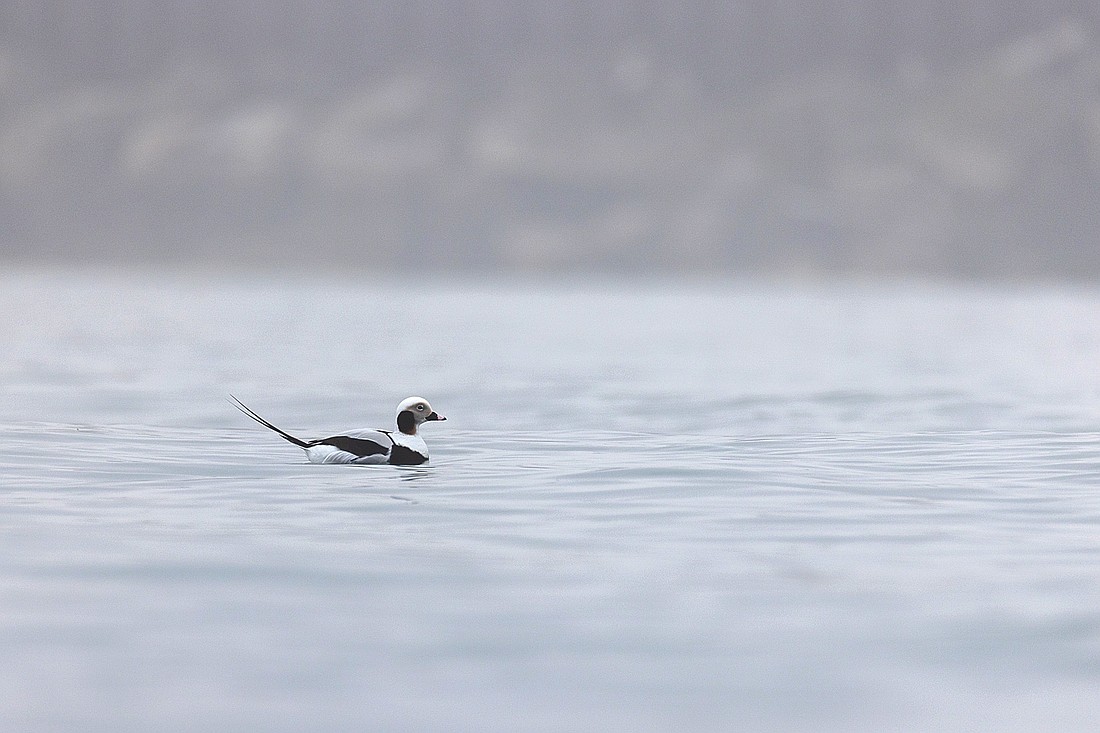
Nearly 1,400 long-tailed ducks were harvested during the hunter harvest survey on Lake Michigan in 2016. Lake Michigan long-tailed ducks feed mostly on small amphipods in the genus diporeia, with diets now shifting more towards zebra and quagga mussels. (Photo by Blake Richard/River News)

By BLAKE RICHARD
Reporter

A study recently published in The Journal of Wildlife Management explained how researchers on Lake Michigan conducted a long-tailed duck hunter survey out of Two Rivers to help address a lack of harvest information and discuss management implications for the species. It was part of a larger study of long-tailed ducks on Lake Michigan that began nearly a decade ago.

“Annual waterfowl harvest in North America is estimated through a collaborative and strategic process,” the study’s abstract read. 

Federal harvest surveys are the primary method of estimation the study explained, but sea duck hunters represent a small portion of overall waterfowl hunters. It went on to say this disproportion limits the utility of harvest estimates for sea ducks, making management decisions difficult for sea duck species like long-tailed ducks. 

Collectively, sea ducks are a group of diving ducks with specialties in marine environments. 

Though long-tailed ducks are technically a sea duck, they utilize freshwater perhaps more than some of their counterparts, especially on the Great Lakes. A few have even been documented on inland lakes in Northern Wisconsin.

Though research is still expanding on the species, a number of long-tailed ducks with implanted satellite transmitters migrated from Lake Michigan to the Canadian Arctic. 

“(Long-tailed ducks) surgically implanted with satellite transmitters from Lake Michigan migrated to the northern half of Nunavut, Canada,” Luke Fara wrote in an email. Fara is currently a biologist with the United States Geological Survey (USGS) at the Upper Midwest Environmental Sciences Center in La Crosse, and a co-author of the study.

“All (long-tailed ducks) from Lake Michigan stayed west of Hudson Bay, however, (long-tailed ducks) marked on other Great Lakes and Atlantic Coast did use areas east of Hudson Bay,” he added. 

As part of the larger long-tailed duck study around Lake Michigan, Fara also completed his masters degree from Southern Illinois University Carbondale (Southern Illinois) looking at migration patterns, habitat use, prey items, and hunter harvest of long-tailed ducks that overwinter on Lake Michigan.

“Historically, on Lake Michigan, (long-tailed ducks) used to eat primarily an amphipod called diporeia,” Fara said in an interview with the Times.

“Like a smaller freshwater shrimp,” he compared them to. 

“Now, they still feed a little bit on diporeia, but we also see a lot of big change over feeding on zebra mussels and quagga mussels,” Fara explained. Yellow perch and alewife were also detected in long-tailed duck carcasses donated by hunters during Fara’s graduate work.

A component of Fara’s research at Southern Illinois included the hunter harvest survey in Two Rivers. 

“This was just one portion of a larger study evaluating (long-long-tailed ducks) on Lake Michigan,” Fara explained in an email. “The hunter and harvest portion of the study was conducted to provide resource managers with information on hunter desires, as well as some assessment of what environmental conditions impact both hunter participation and harvest of long-tailed ducks on Lake Michigan.”

The in-person hunter harvest survey part of the study took place from November 1 through December 4, 2016 at a boat launch in Two Rivers. Of the 1,431 sea ducks hunters harvested during that time, 97 percent were long-tailed ducks, and hunters averaged 3.8 long-tailed ducks per hunter per day throughout the survey. 

The study found wave height to be the most influential factor in hunter participation, while temperature likely had the most influence on long-tailed duck harvest when hunters were able and willing to go out. 

“Hunter participation decreased by 91.9 percent (95 confidence interval) for each (1 meter) increase in wave height,” the study concluded using a calculated model. 

“Long-tailed duck harvest was positively associated with air temperature,” the study said. “The relationship indicated a 9.5 percent (95 percent confidence interval) increase in long-tailed duck harvest with each degree increase in temperature.” 

One of the main comments provided by the hunters surveyed was an expressed desire for a season that goes longer or later into the calendar year.

Since 2021, the wisconsin waterfowl regulations have included a three zone structure, including an Open Water Zone on Lake Michigan.

The Open Water Zone runs later into the calendar year, typically starting the second or third Saturday in October. 

This coming (2026) season, dates for the three duck zones include; September 26 through November 24 for the Northern Duck Zone, October 3 through October 11 and October 17 through December 6 for the Southern Duck Zone, and October 17 through December 15 for the Open Water Duck Zone. See the waterfowl hunting page on the DNR website for more information. 

Blake Richard may be reached via email at [email protected].


Comments:

You must login to comment.

MINOCQUA WEATHER

WEATHER SPONSORED BY

250 X 250 AD
250 X 250 AD
250 X 250 AD

Events

June

SU
MO
TU
WE
TH
FR
SA
31
1
2
3
4
5
6
7
8
9
10
11
12
13
28
29
30
1
2
3
4
SUN
MON
TUE
WED
THU
FRI
SAT
SUN MON TUE WED THU FRI SAT
31 1 2 3 4 5 6
7 8 9 10 11 12 13
14 15 16 17 18 19 20
21 22 23 24 25 26 27
28 29 30 1 2 3 4

To Submit an Event Sign in first

Today's Events

No calendar events have been scheduled for today.

250 X 250 AD